A way into the work.
Blended Grappling studies how people manage balance, contact, and position from standing exchanges to the ground. Our practice draws on several traditions and uses partner games to explore what connects them. The emphasis is on understanding relationships rather than collecting submissions.
Multiple roots
There is no single region of origin for this blend. Lyceum’s own curriculum notes identify influences from Japanese Judo, Brazilian Jiu-Jitsu, Combat Submission Wrestling, Silat, and Tai Chi. Each contributes a different perspective; their presence here does not make our program a complete curriculum or rank pathway in every contributing art.
What are we really practicing?
Position makes movement possible
Before asking what technique to use, we look at the relationship between bodies. Where is your weight? What supports your partner? Which direction can either of you move? Framing, posture, and off-balancing become ways of changing those possibilities.
Transitions deserve their own practice
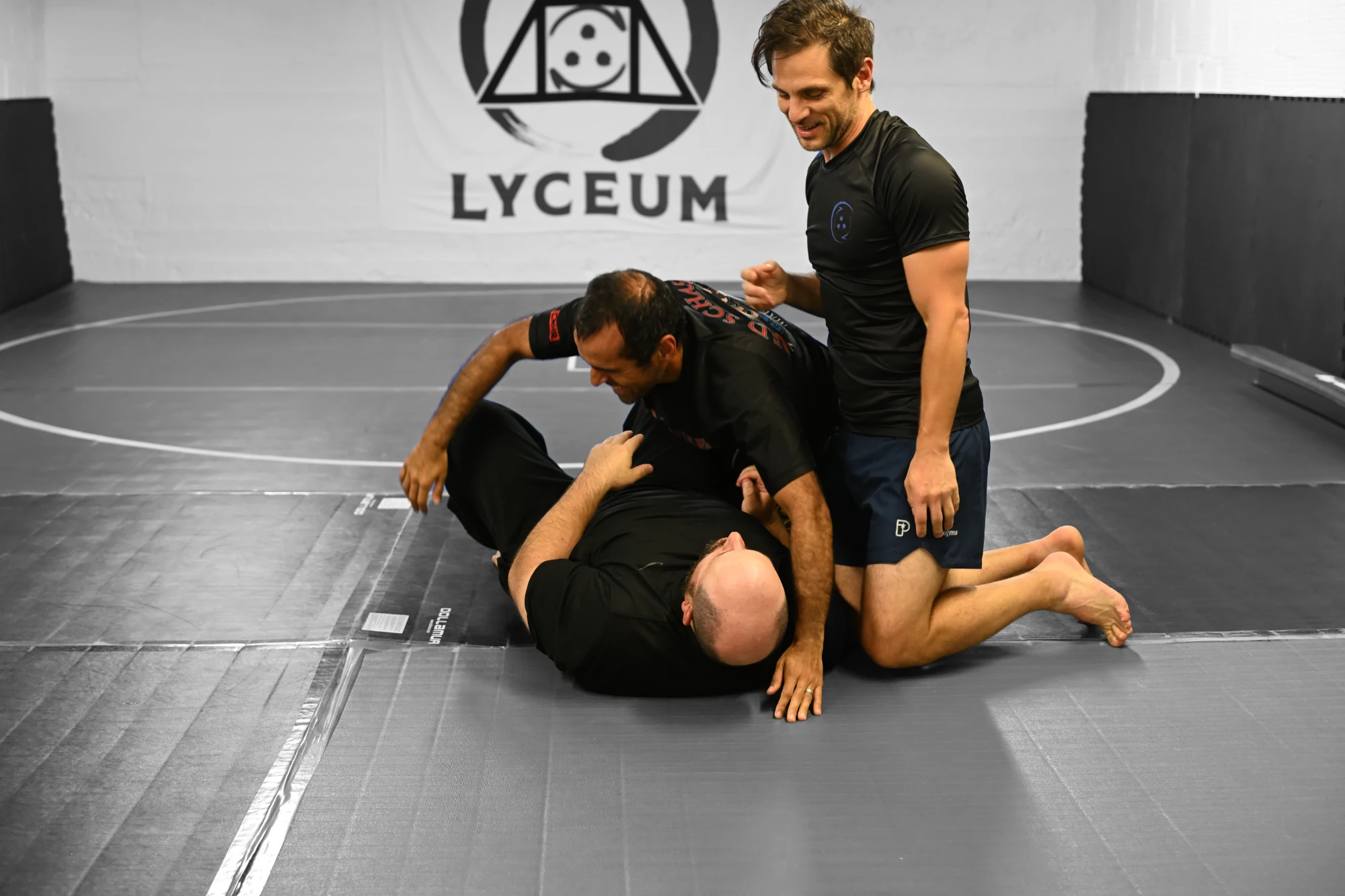
A throw, a pin, and an escape are not isolated events. Often the decisive moment arrives between recognizable positions. Starting a game in a limited situation lets partners study that transition repeatedly, then vary the resistance and available responses.
Cooperation and resistance work together
A partner needs enough freedom to reveal whether an idea works, and enough care to keep the exchange useful. We agree on the task, communicate limits, and release promptly when a partner taps. Good rounds leave both people with clearer information and the ability to return.
A question to take to the mat:
What changes if you improve your position before increasing your effort?
Lyceum’s approach, adapted from The Big List and our notes on learning and partnership.